




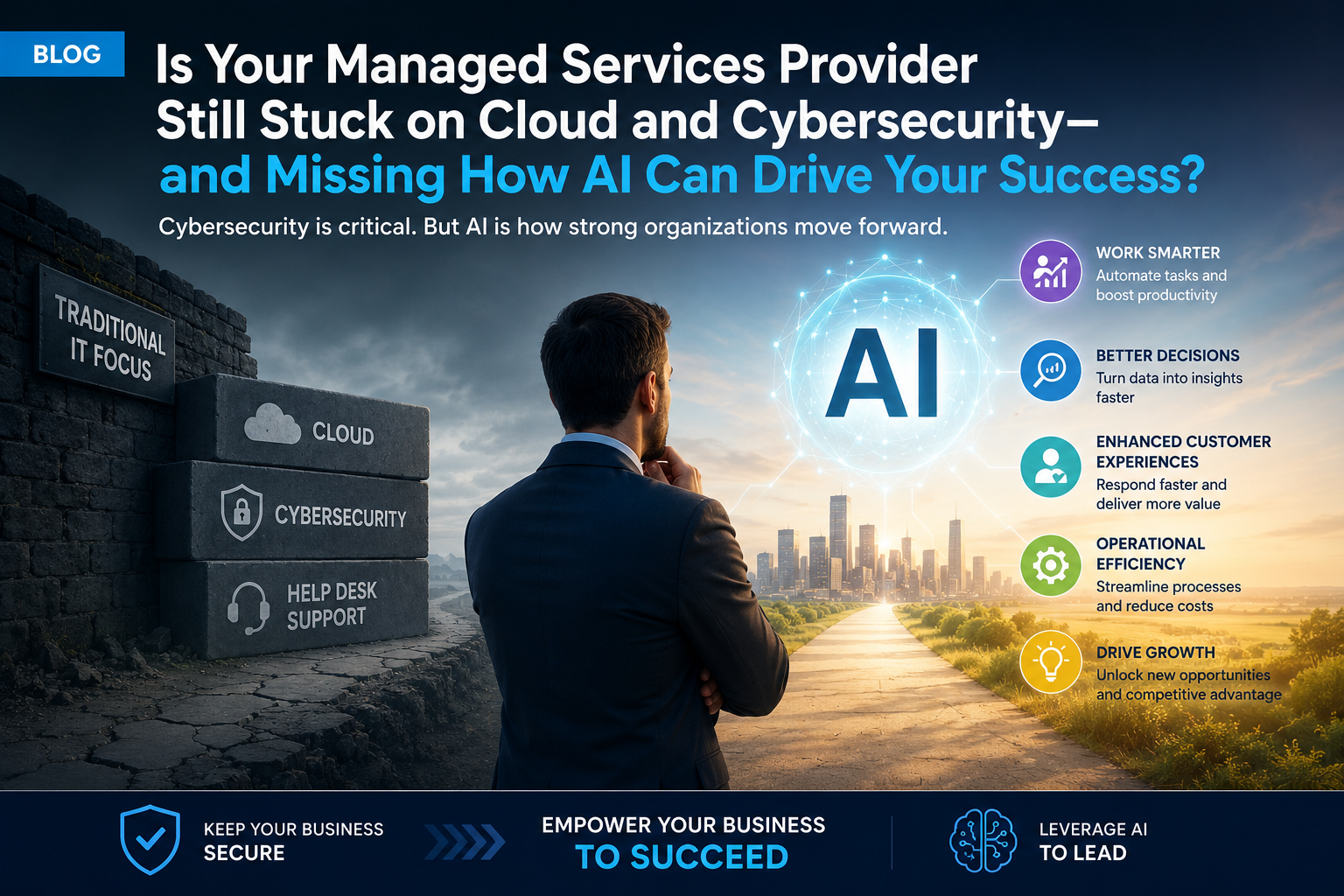
Your IT Provider Mastered the Cloud. Is It Ready for the Age of A.I.?
For years, managed IT services companies have built their value around two major priorities: moving businesses to the cloud and protecting them from cyber threats.
Both remain essential.
Cloud platforms have transformed how organizations store information, support remote teams and operate across multiple locations. Cybersecurity is now a basic business requirement. Every organization needs strong protection, reliable backups, secure identities and a clear plan for responding to an attack.
But the technology conversation has changed.
Artificial intelligence is beginning to reshape how organizations operate, compete, serve customers and make decisions. Yet many managed services providers remain almost entirely focused on cybersecurity, cloud migrations, software licensing and technical support.
They may be protecting your organization.
But are they helping it become more successful?
Cybersecurity Is Critical—but It Is No Longer Enough
No responsible business should reduce its investment in cybersecurity.
The risks are too serious. Ransomware, phishing, account compromise, data theft and operational disruption can cause enormous financial and reputational damage.
A capable managed services provider should continue to strengthen your security posture, monitor your environment and help employees recognize emerging threats.
However, cybersecurity is primarily defensive.
It protects what your organization already has.
AI, when used properly, can help your organization improve how it works, create new capabilities and produce better business outcomes.
The strongest IT providers should be able to do both.
They should protect your organization from technology risks while also helping you use technology to become more productive, responsive and competitive.
Many Managed Services Providers Are Still Thinking Like It Is 2020
A traditional managed services conversation often focuses on familiar topics:
- Are your computers patched?
- Is your information backed up?
- Are employees using multifactor authentication?
- Should more systems be moved to the cloud?
- Is your firewall properly configured?
- Are your software licences current?
These are important questions.
But they are no longer the only questions your IT provider should be asking.
A forward-thinking provider should also ask:
- Which repetitive tasks are consuming employee time?
- Where are customers waiting too long for answers?
- What information is difficult for employees to find?
- Which processes create unnecessary errors or delays?
- What reports take hours to prepare manually?
- Where could AI help employees make faster decisions?
- Which areas of the organization could benefit from automation?
- How could AI help management identify opportunities earlier?
These are business questions—not simply technology questions.
That distinction matters.
An IT company that understands AI must understand more than software. It must understand how your organization operates and where technology can produce measurable improvement.
Installing AI Is Not the Same as Creating an AI Strategy
Some managed services providers have begun adding AI to their sales presentations.
They may mention Microsoft Copilot, ChatGPT, automated help desks or AI-powered security tools.
But mentioning AI does not mean they understand it.
A provider that recommends the same AI product to every customer is not creating a strategy. It is reselling software.
A meaningful AI strategy should begin with the organization’s goals.
For example:
- A professional services firm may want to reduce the time required to prepare proposals and client reports.
- A construction company may want to summarize project notes and identify delays earlier.
- A healthcare organization may want employees to locate policies and procedures more quickly.
- A retailer may want to improve customer-response times and inventory forecasting.
- A manufacturer may want to analyze maintenance records and reduce equipment downtime.
- A nonprofit organization may want to automate administrative work and improve donor communications.
These organizations do not need identical AI solutions.
They need a provider capable of identifying where AI can solve real operational problems.
AI Should Help Employees Perform Better
The conversation around AI is often dominated by job replacement.
That misses one of the greatest opportunities.
For many organizations, AI can create value by helping employees perform existing work more effectively.
AI can assist with:
- Drafting routine communications
- Summarizing meetings and documents
- Organizing large amounts of information
- Searching internal knowledge
- Preparing reports
- Analyzing customer feedback
- Identifying patterns in business data
- Automating repetitive administrative tasks
- Categorizing requests and support tickets
- Creating first drafts of policies, procedures and proposals
Used properly, these tools can reduce the amount of time employees spend on low-value tasks.
That gives them more time to focus on customers, solve difficult problems, develop new ideas and support the growth of the organization.
Your managed services provider should understand how to connect AI with daily work—not simply how to activate another software licence.
Your IT Provider Must Understand Your Business
A provider cannot recommend useful AI solutions without understanding how your organization works.
That requires more than an annual technology review.
Your provider should understand:
- How information moves through the organization
- Which systems employees rely on
- Where bottlenecks occur
- Which tasks require significant manual effort
- What customers expect
- How decisions are made
- Which data is sensitive
- Which outcomes matter most to management
Without this knowledge, AI projects often become expensive experiments with little measurable value.
The technology may be impressive, but employees may not use it. It may not connect to the right information. It may solve a problem that was never important.
A strong AI partner begins with the business problem and works backward to the technology.
Data Readiness Is Part of AI Readiness
AI depends on information.
If your data is scattered across inboxes, shared folders, outdated databases and disconnected applications, AI will have difficulty producing reliable results.
Before introducing AI, your managed services provider should help determine:
- Where critical information is stored
- Whether the information is accurate
- Who has access to it
- Whether permissions are properly configured
- Which data can be used with external AI platforms
- Whether old or duplicate information should be removed
- How systems can securely connect
- How AI-generated results will be reviewed
This is where cloud expertise remains valuable.
Cloud computing provides much of the infrastructure that makes modern AI possible. But the conversation should move beyond simply hosting applications online.
The real objective is to ensure that your information is organized, secure and usable enough to support better decisions and more efficient operations.
Security Must Be Built Into AI Adoption
AI does not replace cybersecurity.
In fact, AI creates new security and privacy considerations.
Employees may enter confidential information into unapproved AI services. AI tools may be connected to documents with overly broad permissions. Generated content may contain inaccurate information. External platforms may store or process data in ways the organization does not fully understand.
Your managed services provider should help establish:
- An approved list of AI applications
- Rules regarding confidential information
- Access and identity controls
- Data-retention requirements
- Employee training
- Human-review standards
- Procedures for reporting inaccurate results
- Oversight for new AI tools
- A process for reviewing vendors and integrations
Cybersecurity and AI strategy should not compete with each other.
They should work together.
The goal is not to prevent employees from using AI. The goal is to help them use it safely, responsibly and effectively.
Warning Signs Your Managed Services Provider Is Falling Behind
Your provider may not be ready to guide your AI journey if it:
- Talks almost exclusively about cybersecurity
- Treats cloud migration as the final stage of digital transformation
- Cannot identify specific AI opportunities within your organization
- Recommends a product before understanding your processes
- Has no AI acceptable-use policy
- Cannot explain how AI platforms handle your information
- Focuses only on AI-powered security tools
- Has no plan for employee training
- Cannot measure the value of an AI project
- Dismisses AI as a passing trend
- Uses AI terminology without providing practical examples
- Has no roadmap for helping clients adopt AI
A provider does not need to have every answer.
AI is evolving quickly, and no one can predict every future development.
However, your provider should be actively learning, testing tools, developing policies and building the skills required to advise clients responsibly.
Standing still is not a strategy.
What a Modern Managed Services Provider Should Deliver
A modern managed services provider should still deliver dependable support, strong cybersecurity, reliable backups and well-managed cloud services.
But that should be the foundation—not the limit—of the relationship.
Your provider should also help you:
- Identify high-value AI opportunities
- Automate repetitive work
- Improve access to organizational knowledge
- Establish responsible AI policies
- Prepare and organize business data
- Select secure AI platforms
- Integrate AI into existing workflows
- Train employees
- Launch controlled pilot projects
- Measure productivity and business outcomes
- Develop a long-term AI roadmap
The role of the managed services provider must evolve from technical support company to strategic technology advisor.
Your Competitors May Already Be Moving Ahead
The greatest risk of ignoring AI may not be a failed technology project.
It may be watching competitors become more efficient, responsive and innovative while your organization continues operating the same way it did five years ago.
Businesses that learn how to use AI effectively may be able to:
- Respond to customers faster
- Produce work with fewer delays
- Analyze opportunities more quickly
- Reduce administrative costs
- Improve employee productivity
- Deliver more personalized services
- Make better use of organizational knowledge
- Scale without adding unnecessary complexity
AI will not automatically make every organization successful.
But organizations that develop the ability to use it strategically may create a significant advantage over those that do not.
Protecting Your Business Is Only Half the Job
Your managed services provider should absolutely protect your organization.
Cybersecurity is critical. Cloud technology remains important. Reliable support is essential.
But protecting the status quo is not the same as helping your organization grow.
The future of managed IT services will belong to providers that can combine cybersecurity, cloud infrastructure, automation, data management and artificial intelligence into a practical business strategy.
Your IT provider should not only ask how it can keep your systems running.
It should ask how technology can help your organization operate better, serve customers more effectively and achieve greater success.
Is your managed services provider helping your organization prepare for an AI-driven future—or is it still having the same technology conversation it was having five years ago?